
Summarize this blog post with:


Quick commerce marketing services are entering a transformative phase as India’s instant delivery sector prepares for unprecedented changes in 2026. The landscape that brands navigate today will look dramatically different in just twelve months, with quick commerce platforms like Blinkit, Zepto, and Instamart pioneering innovations that will redefine consumer expectations. For brands invested in quick commerce advertising, understanding these emerging trends isn’t optional – it’s essential for survival.
The quick commerce industry in India has grown from a pandemic-era experiment to a $7.4 billion market, with projections indicating it will reach $40 billion by 2030. As we stand at the threshold of 2026, quick commerce marketing must evolve to address profitability pressures, technological disruptions, and shifting consumer behaviors that will shape q commerce in India.
Join our Quick Commerce LinkedIn community to connect with industry leaders and stay ahead of these transformative trends as they unfold.
Table of Contents
- The Dark Store Revolution: Infrastructure Expansion
- Path to Profitability: Unit Economics Finally Making Sense
- Geographic Expansion: Tier 2 and 3 Cities Enter the Arena
- Category Explosion: Beyond Groceries
- AI and Automation: The Technology Backbone
- Sustainability Mandates: Green Quick Commerce
- The Consolidation Wave: Market Power
- Regulatory Landscape: Government Intervention
- Employment Revolution: The Gig Economy at Scale
- Omnichannel Integration: Blurring Retail Lines
1. The Dark Store Revolution: Infrastructure Expansion
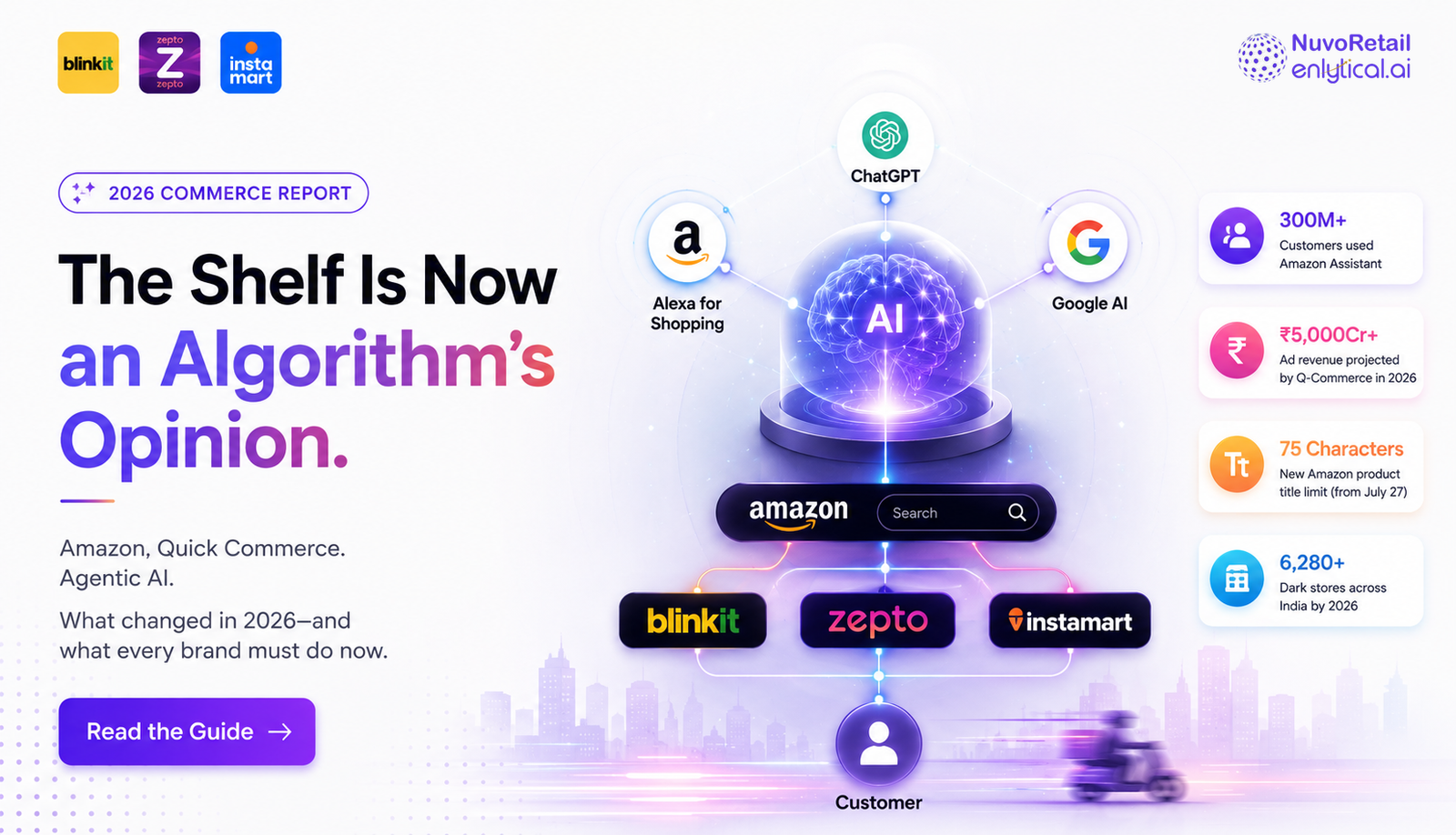
The foundation of quick commerce marketing success in 2026 lies in dramatic dark store infrastructure expansion. Industry projections indicate that quick commerce platforms will operate 5,000-5,500 dark stores across India by fiscal year 2026, up from approximately 2,500 in early 2024.
Blinkit plans to reach 2,000 dark stores by end of 2026, while Zepto targets 1,000 locations. These micro-fulfillment centers – typically 2,000-8,000 square feet located within residential neighborhoods – are becoming the lifeblood of quick commerce operations.
For brands pursuing quick commerce advertising services, this infrastructure boom creates both opportunities and complexities. More dark stores mean expanded geographic coverage and granular customer segmentation. However, it requires sophisticated inventory distribution strategies and real-time stock management across hundreds of locations.
Quick commerce marketing India strategies must adapt to this hyper-localized reality. Products that perform well in one neighborhood might languish in another just kilometers away. Brands need dark store-level analytics and the ability to customize assortments based on micro-market preferences.
2. Path to Profitability: Unit Economics Finally Making Sense
The most critical trend shaping quick commerce marketing in 2026 is the sector’s pivot from growth-at-all-costs to sustainable profitability. After years of aggressive subsidization, major q commerce platforms are projecting contribution margin positivity and clear paths to EBITDA breakeven.
Q-commerce contribution margins are expected to reach +6-7% by end of 2026, driven by:
Revenue Growth: Average Order Value has increased from ₹300-400 to ₹500-700 through strategic category expansion. Quick commerce advertising services now generate meaningful revenue streams through sponsored listings and banner advertisements.
Cost Optimization: Mature dark stores process 1,000-2,000 orders daily, dramatically improving unit economics. Delivery costs have dropped from ₹70-80 to ₹50-60 per order through route optimization.
For quick commerce marketing services providers, this profitability focus fundamentally changes platform relationships. Performance marketing that demonstrably drives high-margin orders will command premium placement, while low-value promotions face increasing scrutiny.
3. Geographic Expansion: Tier 2 and 3 Cities Enter the Arena
Quick commerce marketing strategies developed for metros face their first major test as platforms aggressively expand into Tier 2 and Tier 3 cities throughout 2026. Since 2020, nearly 60% of new e-retail customers have emerged from smaller cities, projected to account for 50% of India’s e-commerce activity by 2026.
Swiggy Instamart has entered 11 new cities including Thrissur, Mangalore, Kanpur, Udaipur, and Varanasi. Remarkably, some Tier 2 stores achieve 1,000 daily orders faster than metro locations. Blinkit has expanded to Kochi, Bathinda, and Vijayawada.
What Makes Tier 2/3 Different:
Regional preferences require partnerships with local brands. Language localization is critical, with 53% of non-metro consumers preferring native language apps. Price sensitivity remains higher than metros. However, lower real estate costs enable faster breakeven (9-12 months versus 18-24 months in metros).
For quick commerce advertising services, brands must develop truly localized strategies. Creative assets, messaging, and product mixes need customization based on local culture and festivals. The opportunity is massive – India’s urban population increased by 11 million in 2023 alone.
4. Category Explosion: Beyond Groceries
The future of quick commerce marketing lies in transformation from “grocery delivery” to “everything in minutes” commerce. Partnerships between quick commerce platforms and D2C brands have resulted in a 24× increase in order value since FY22. D2C brands now contribute over 30% of total sales.
High-Growth Categories in 2026:
Electronics: This segment expands at 9.21% CAGR. Smartphones, earbuds, and accessories with AOV of ₹1,500-3,000 significantly exceed grocery baskets.
Beauty and Personal Care: Brands like Earth Rhythm scaled from $6,000 to $180,000 in monthly sales within 18 months on Blinkit.
Fashion and Apparel: Quick commerce is entering basic fashion – innerwear, t-shirts, and activewear. Myntra’s M-Now and Nykaa’s NykaaNow validate the category’s potential.
Pet Care, Toys, Gourmet Foods: High-frequency, high-margin categories ideal for quick commerce. Brands like 4700BC gourmet popcorn generate 87% of sales through quick commerce platforms India.
For quick commerce advertising services, category expansion requires completely different approaches – visual merchandising for electronics, discovery mechanisms for fashion, and seasonal planning for toys. Brands in emerging categories have extraordinary first-mover advantages before shelf space becomes intensely competitive.
5. AI and Automation: The Technology Backbone
Artificial intelligence represents the invisible force multiplier determining which quick commerce marketing strategies succeed in 2026. While consumers experience seamless 10-minute deliveries, sophisticated AI systems orchestrate every operation aspect.
AI Applications:
Demand Forecasting: Machine learning analyzes historical sales, weather, events, and festivals to predict demand at individual dark store levels, enabling pre-positioned inventory.
Dynamic Pricing: Real-time optimization adjusts based on demand elasticity, inventory levels, and competition.
Route Optimization: AI calculates optimal delivery routes considering traffic, rider locations, and order batching.
Personalized Recommendations: Collaborative filtering drives product discovery and increases basket sizes.
Voice Commerce: By 2026, 15-20% of quick commerce orders are expected to originate from voice commands.
For quick commerce marketing professionals, AI creates algorithmic visibility challenges similar to SEO. Understanding how platform algorithms determine product placement becomes crucial. The competitive advantage increasingly belongs to brands with superior data science capabilities, making quick commerce marketing India a battle of algorithms as much as brands.
6. Sustainability Mandates: Green Quick Commerce
By 2026, environmental pressures will force significant evolution in quick commerce marketing as both regulatory demands and consumer expectations require greener solutions. Over 70% of Indian consumers now consider sustainability in purchasing decisions.
Green Quick Commerce Initiatives:
Platforms are transitioning to electric vehicle fleets, with 30-40% of deliveries expected via EVs in major cities by 2026. Sustainable packaging moves away from single-use plastics. AI-driven route optimization reduces emissions per delivery. Some platforms offer carbon offset programs.
For quick commerce advertising services, sustainability creates new positioning opportunities. Brands can highlight eco-friendly packaging and local sourcing. However, the risk is greenwashing—consumers are sophisticated at identifying superficial environmental claims. Quick commerce marketing India must be built on authentic sustainable practices.
7. The Consolidation Wave: Market Power
The fragmented quick commerce landscape will give way to concentrated market power by 2026. Currently, Blinkit, Zepto, and Swiggy Instamart command approximately 90% of India’s quick commerce market. This oligopolistic structure will intensify as weaker players exit and new entrants face high barriers.
Implications for Quick Commerce Advertising Services:
Market concentration shifts negotiating power from brands to platforms. With fewer alternatives, brands face reduced bargaining power over commissions and terms. However, consolidated players invest in sophisticated quick commerce marketing services tools – better analytics, targeting, and promotional mechanisms.
Brands must build strong platform relationships early, diversify across platforms where possible, and invest in platform-specific expertise. The consolidation wave creates winners and losers—those securing favorable positions early gain compounding advantages.
8. Regulatory Landscape: Government Intervention
Quick commerce’s explosive growth has attracted regulatory scrutiny, and 2026 will see significant government intervention. The Competition Commission of India has introduced regulations targeting predatory pricing. This directly impacts quick commerce advertising – deep discounts may face restrictions, forcing platforms to compete on service quality rather than unsustainable pricing.
With approximately 200,000 kirana stores closing in the past year, political pressure mounts for protective regulations. Only 10-15% of dark stores currently adhere to municipal zoning regulations. Stricter enforcement is inevitable, potentially forcing costly relocations.
For quick commerce marketing India, these trends create new considerations. With discount limitations, quick commerce advertising must emphasize genuine value – selection, quality, and convenience. Marketing claims about delivery times and pricing must be defensible. Smart brands view regulation as competitive moat – platforms with robust compliance gain advantages as weaker players struggle.
9. Employment Revolution: The Gig Economy at Scale
Quick commerce represents one of India’s fastest-growing employment sectors, with projections indicating 2.4 million jobs by 2027. This includes delivery riders, dark store staff, technology teams, and indirect employment through suppliers and vendors.
Most delivery riders are gig workers rather than traditional employees, creating flexibility but raising concerns about income stability, working conditions, and benefits.
The Marketing Dimension:
How platforms treat workers affects brand reputation. Rider satisfaction directly impacts delivery experience and brand perception. Employment creation can be powerful quick commerce advertising content – “supporting local livelihoods” resonates with socially conscious consumers.
For quick commerce marketing services providers, understanding the employment ecosystem is crucial. The human infrastructure executing deliveries determines whether marketing promises become positive experiences. Marketing strategies must be grounded in operational realities.
10. Omnichannel Integration: Blurring Retail Lines
The final critical trend is the blurring of boundaries between retail formats. Quick commerce, traditional e-commerce, physical retail, and social commerce are converging into integrated omnichannel ecosystems.
Traditional retailers like Reliance (JioMart) and Tata (Neu Flash) are launching quick commerce arms. E-commerce giants Flipkart (Flipkart Minutes) and Amazon are entering quick commerce. Social platforms increasingly link to quick commerce fulfillment – influencer recommendations can result in products arriving within minutes.
Quick Commerce Marketing in Omnichannel:
Consumers expect seamless experiences across channels. Quick commerce advertising must be coordinated with e-commerce, social, and physical retail. Unified customer data enables holistic understanding, but each channel requires specific optimization.
The omnichannel future means quick commerce marketing cannot exist in isolation. It must integrate into comprehensive retail strategies recognizing consumers fluidly move between channels based on context and urgency.
Conclusion: Preparing for the Quick Commerce Marketing Future
The future of quick commerce marketing in 2026 will be defined by sophisticated infrastructure, sustainable profitability, geographic expansion, category diversification, technological advancement, environmental responsibility, market consolidation, regulatory compliance, employment at scale, and omnichannel integration.
Brands that thrive will invest in deep platform relationships, develop data-driven capabilities, maintain operational excellence, communicate authentic value beyond price, and demonstrate agility. The quick commerce sector is maturing from chaotic adolescence into sophisticated adulthood.
For brands on Blinkit, Zepto, and Instamart, the opportunity remains enormous. India’s quick commerce market will continue growing at 40-45% CAGR, reaching $57 billion by 2030. But capturing this requires sophisticated quick commerce marketing India strategies grounded in evolving realities.
The question is whether your brand will be a beneficiary or casualty of this transformation.
Partner with Experts Who Understand the Future
Quick commerce marketing services from NuvoRetail are built on deep understanding of these transformative trends. Our team has helped hundreds of brands navigate the complexities of quick commerce platforms, optimizing performance on Blinkit, Zepto, and Instamart while preparing for dramatic changes ahead.
We don’t just react to trends – we anticipate future shifts. From dark store optimization to AI-powered forecasting, from Tier 2/3 strategies to omnichannel integration, our comprehensive quick commerce advertising services cover every dimension.
The brands dominating quick commerce marketing in 2026 are taking action today. Contact us to discuss how NuvoRetail’s specialized quick commerce marketing services can position your brand for the future.
Explore our insights on quick commerce advertising trends and consumer behavior shifts. Learn from marketing trends India 2026 analysis.
Join our thriving Quick Commerce LinkedIn community to connect with industry professionals, share insights, and stay updated on the latest trends shaping q commerce in India. Network with brand managers, platform experts, and marketing professionals navigating the quick commerce revolution.
Don’t wait for 2026 unprepared. Partner with NuvoRetail and turn emerging trends into competitive advantages.