Holiday E-commerce Strategy: How to Win India’s Second Peak, From Black Friday to New Year
On This Page
- 1. Map the second peak before you plan the spend
- 2. Pace your budget in phases, not in one burst
- 3. Change the creative, not just the discount
- 4. Bring your Diwali buyers back
- 5. Show up wherever the gift gets bought
- 6. Set rules before the rush, not during it
- 7. Measure what the season really added
- Your year-end holiday ecommerce strategy checklist
- Frequently asked questions
- Conclusion: The second peak belongs to the prepared
- Want a second pair of eyes on your year-end plan?
Your Diwali campaigns are done, but your holiday ecommerce strategy is still there.
We get it. The team has been running on coffee and dashboards since September, the festive report is finally out, and everyone has quietly earned a long weekend. It’s tempting to switch to “maintenance mode” until January.
Then you open the calendar. Black Friday lands on November 27. India’s wedding season runs alongside it, with the Confederation of All India Traders (CAIT) estimating around 52 lakh weddings and ₹7.5 lakh crore in business between November 21 and December 15. Christmas and New Year gifting follow straight after, and the Republic Day sales are only a few weeks away.
That’s India’s second peak, and it rewards a different kind of holiday ecommerce strategy: one built for gifting, last-minute orders and returning shoppers rather than one giant sale.
Are you still wondering, how to plan it?
1. Map the second peak before you plan the spend
Diwali is one big moment. The year-end stretch is a series of smaller ones, each with a different shopper in mind.
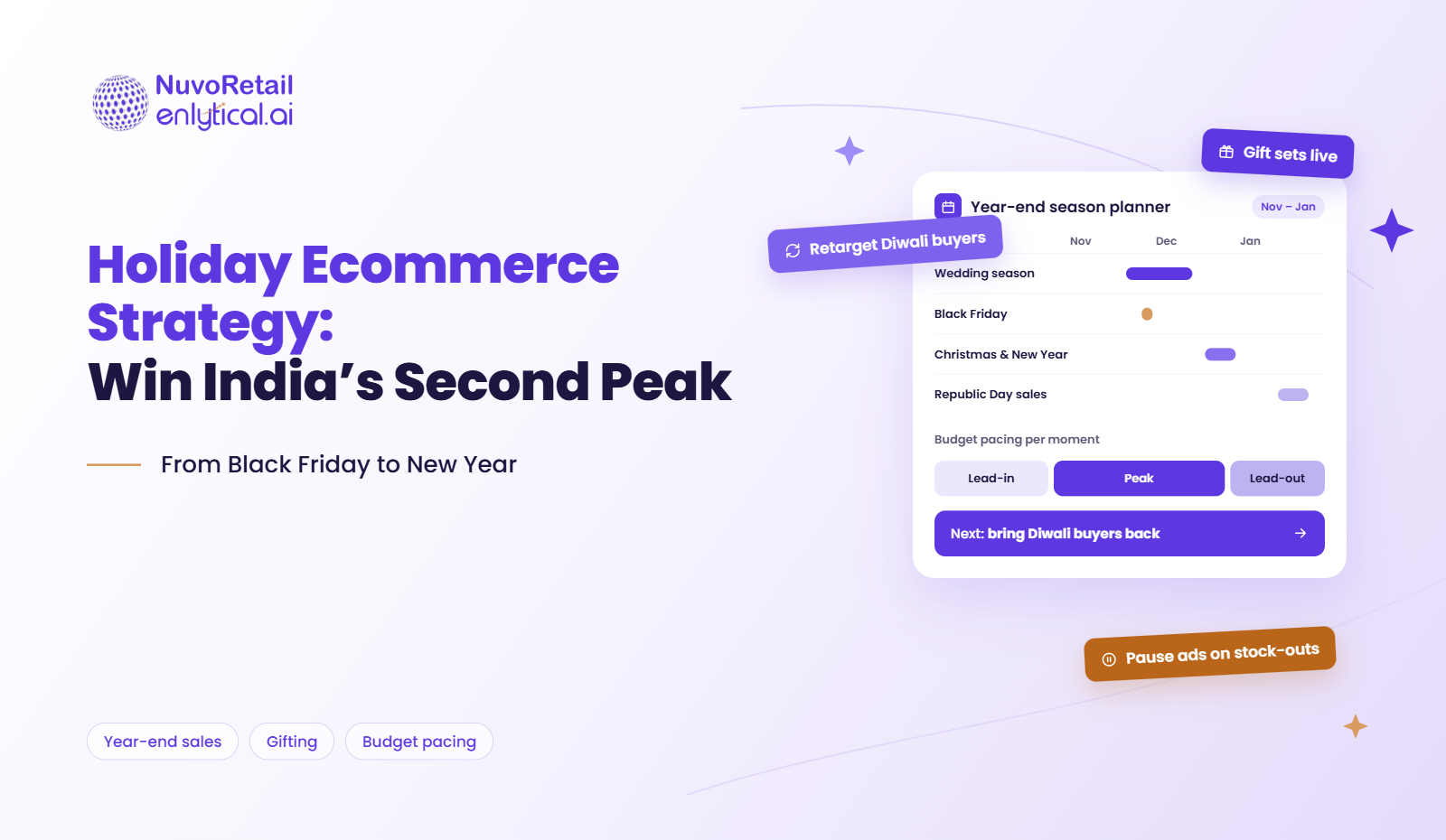
| Moment | Rough window | What shoppers want |
| Wedding season | November 21 to December 15 | Gifts, fashion, jewellery, beauty, home and kitchen |
| Black Friday | Around November 27 | Deals on electronics, fashion and beauty |
| Christmas and New Year | Mid to late December | Gifting, party essentials, last-minute orders |
| Republic Day sales | January | Big-ticket and stock-up purchases |
A good holiday ecommerce strategy starts by deciding which of these moments matter for your category, and which ones you’ll simply ride.
2. Pace your budget in phases, not in one burst
The biggest budget mistake of the season is spending too much, too early. Experts’ review of last year’s sales found that advertisers who held more budget for the core sale window saw sales grow faster than spend, while advertisers on marketplaces who ramped up early didn’t get the same payoff.
Plan each moment in three phases:
- a lead-in to build awareness and remarketing pools
- a peak where you push hardest on conversion
- a lead-out to capture late buyers.
Keep a reserve so a strong day can be scaled easily, not starved.
3. Change the creative, not just the discount
A Diwali banner in mid-December looks tired. Shoppers in this stretch are buying for someone: a wedding gift, a Secret Santa, a New Year treat. Your holiday ecommerce strategy should speak to that.
Refresh main images and A+ Content with gifting angles, build bundles and gift sets, and use video to show the product as a present, not just a purchase. Small touches like “arrives before the 15th” can matter more than an extra 5% off.
4. Bring your Diwali buyers back
You just paid to acquire thousands of new customers. The cheapest growth this season is selling to them again.
Use AMC audience segmentation to split festive buyers by what they bought and when, then build an Amazon DSP retargeting strategy around them: replenishment reminders for consumables, complementary products for durables, and gifting suggestions for everyone. For many brands, this is the highest-return line in their whole holiday ecommerce strategy.
5. Show up wherever the gift gets bought
Holiday shoppers don’t stay in one app. They compare on Amazon and Flipkart, check your D2C site, and increasingly order last-minute gifts on quick commerce when the party is tomorrow.
Make sure hero products, pack sizes and gift sets are live and in stock on each channel that matters for your category, with consistent pricing and content. A gift that can arrive in 10 minutes on Blinkit or Zepto wins over one that arrives on Tuesday.
6. Set rules before the rush, not during it
Peak days move faster than any team can manually. Decide your rules in advance: pause ads when a SKU goes out of stock, cap bids when CPCs spike, shift budget towards campaigns beating target, and set alerts for sudden drops in share.
In a strong holiday ecommerce strategy, automation isn’t the goal. It’s making sure no rupee is spent on a product the shopper can’t buy.
7. Measure what the season really added
Holiday ROAS always looks healthy, because shoppers arrive ready to buy. Judge your holiday ecommerce strategy on what the season actually added: incremental sales, new-to-brand customers, contribution margin after discounts and returns, and how many festive buyers come back in January.
Your year-end holiday ecommerce strategy checklist
| Area | Ready when… |
| Calendar | You’ve picked the moments that matter for your category |
| Budget | Each moment has a lead-in, peak and lead-out, plus a reserve |
| Creative | Gifting angles, bundles and delivery promises are live |
| Retention | Diwali buyers are segmented and in retargeting audiences |
| Channels | Hero SKUs are live and in stock on every key platform |
| Rules | Stock, bid and budget rules are set before peak days |
| Measurement | You’re tracking incrementality, NTB and margin, not just ROAS |
Frequently asked questions
What is a holiday ecommerce strategy? It’s a plan for how a brand will drive and capture online demand across the year-end shopping season, covering the sale calendar, budget pacing, creative, channels, inventory and measurement.
Does Black Friday matter for ecommerce brands in India? It has become a meaningful sale moment, especially for electronics, fashion and beauty, and in India it now overlaps with the wedding season. Treat it as one moment in a longer year-end plan rather than a standalone event.
How should I split budget between Diwali and the year-end season? There’s no fixed ratio. Use your Diwali data to see which categories and audiences still have room to grow, keep a reserve for peak days, and put a meaningful share into retargeting festive buyers.
Conclusion: The second peak belongs to the prepared
Diwali gets the headlines. But the weeks that follow, with weddings, Black Friday, Christmas and New Year, quietly decide how strong your year ends and how fast January starts.
A smart holiday ecommerce strategy for this stretch isn’t about another giant sale. It’s about the right moments, paced budgets, gifting-led creative, and turning festive buyers into repeat ones. That’s how we plan the season at NuvoRetail, across Amazon Marketing Services, quick commerce and performance media, with enlytical keeping every channel in one view.
Want a second pair of eyes on your year-end plan?
Talk to the NuvoRetail team, and we’ll help you map the moments, pace the budget and bring your Diwali buyers back.