
Summarize this blog post with:




| Quick answer: Wondering how to use AMC without SQL? Amazon’s agentic AI – first a SQL Generator launched in January 2025, then the fuller “Ads Agent” launched in November 2025 – now lets marketers type a plain-English question inside Amazon Marketing Cloud (AMC) and get back a working SQL query automatically. No coding, no data analyst, and no query editor required. |
For years, Amazon Marketing Cloud (AMC) has been sold on a simple promise: give advertisers a privacy-safe “clean room” where they can stitch together signals from Sponsored Ads, DSP, and Amazon’s retail data to understand the full customer journey. The problem was access. AMC’s real power lived behind SQL – and SQL belonged to data analysts, not the brand managers and marketers who actually needed the answers.
That’s exactly the gap this guide addresses. If you’ve been asking how to use AMC without SQL, the short answer is: agentic AI now does the coding for you. Below, we’ll walk through what changed, how Amazon’s natural-language tools evolved, how the technology works under the hood, and a practical step-by-step approach any marketer can follow – no SQL background required.
- What Is Amazon Marketing Cloud (AMC)?
- Why Did You Need SQL to Use AMC in the First Place?
- How to Use AMC Without SQL: A Timeline of Amazon’s Agentic AI Rollout
- How to Use AMC Without SQL Actually Work Behind the Scenes?
- 5 Wins Marketers Get From Agentic AI in AMC
- How to Use AMC Without SQL: A Step-by-Step Guide
- What Are the Limitations of Using AMC Without SQL?
- What’s Next for Agentic AI in Retail Media?
- Frequently Asked Questions
- The Bottom Line
- Conclusion
- Ready to Put AMC’s Agentic AI to Work for Your Brand?
What Is Amazon Marketing Cloud (AMC)?
Amazon Marketing Cloud (AMC) is Amazon’s privacy-safe, clean-room analytics platform. It lets advertisers combine pseudonymized, event-level signals – ad impressions, clicks, streaming TV views, DSP exposures, and purchase data – to measure full-funnel performance and build custom audiences.
Because the underlying data is sensitive, AMC has always been query-based: users write SQL against Amazon-hosted tables rather than exporting raw data. That architecture is exactly why AMC delivers deeper insight than a standard ads dashboard – and exactly why so many marketers have spent the last few years searching for a way to use AMC without a technical background.
If you’re new to the platform, it helps to understand this history before diving into how to use AMC without SQL, since the natural-language layer sits directly on top of the same underlying clean-room infrastructure – it doesn’t replace AMC’s privacy protections, it just removes the coding step in front of them.
Why Did You Need SQL to Use AMC in the First Place?
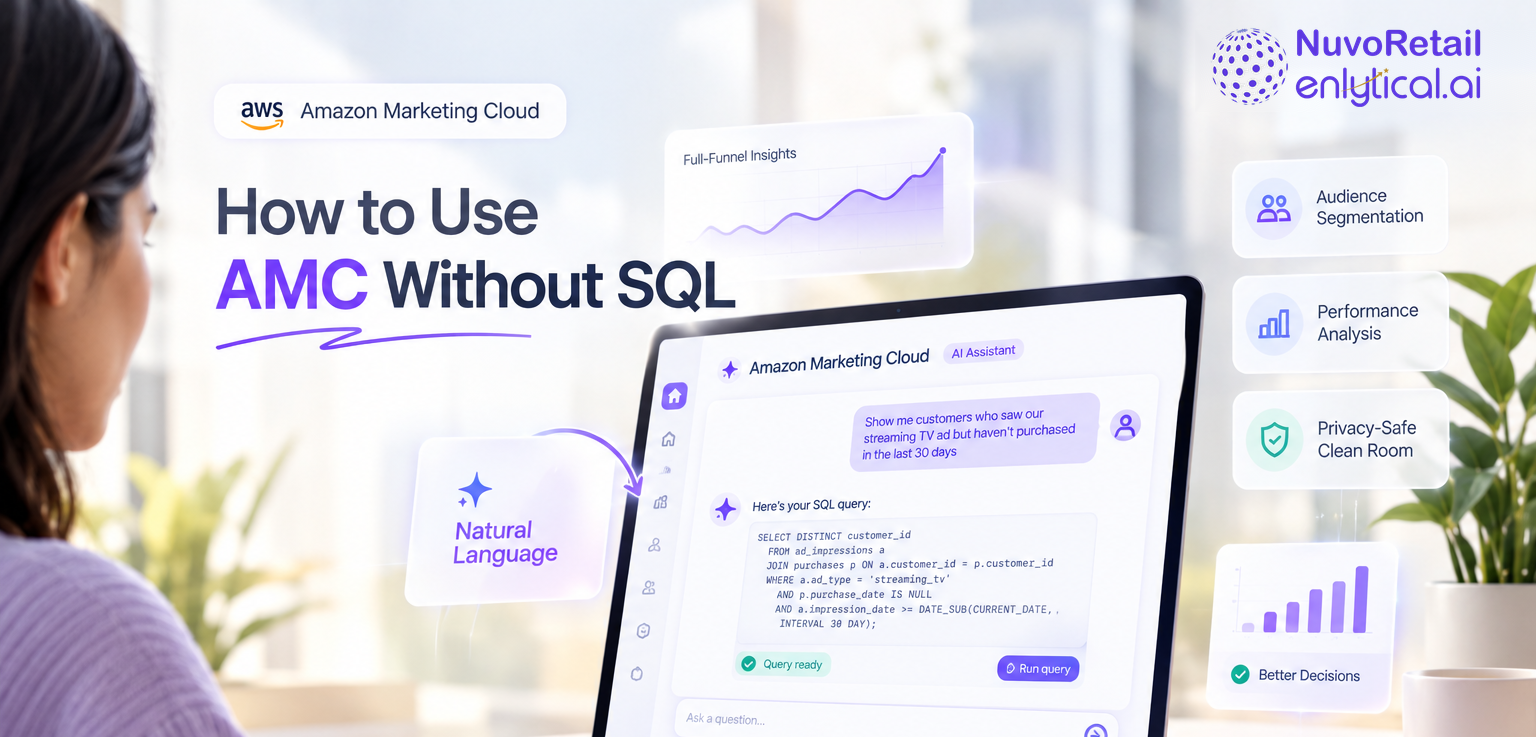
Even a simple business question in AMC – “which customers saw our streaming TV ad but haven’t purchased in 30 days?” – required someone who understood AMC’s specific schema, join logic, and privacy thresholds. Before agentic AI arrived, getting value out of AMC required data engineering expertise, full stop.
For most mid-sized brands, that meant one of three options: hire a specialist, pay an agency, or leave AMC’s data on the table entirely. This is exactly the bottleneck that made so many marketers start searching for how to use AMC without SQL in the first place – and it’s the bottleneck Amazon has spent the last year dismantling.
How to Use AMC Without SQL: A Timeline of Amazon’s Agentic AI Rollout
Amazon rolled out natural-language capability in AMC in four stages over roughly twelve months:
January 2025 — The Original SQL Generator
At CES 2025, Amazon Ads announced a SQL Generator for AMC – the first real answer to how to use AMC without SQL. It let advertisers describe the audience they wanted in natural language and receive the SQL query along with the steps used to build it. An advertiser could ask for customers who viewed product pages and saw a streaming TV ad but hadn’t purchased in the last 30 days, and the tool would produce the underlying SQL automatically.
July 2025 — A Conversational Assistant
Amazon expanded this into a unified chatbot interface inside AMC that could generate audience-segment queries from natural-language prompts and answer product questions instantly, cutting the time it took new users to get value from the platform.
September 2025 — Opening the Door Wider
Amazon made AMC directly accessible to sponsored ads advertisers, removing traditional onboarding barriers, and paired that access with no-code templates and AI-assisted guidance built into the advertising console. Brands no longer needed a DSP relationship or a lengthy provisioning process just to start exploring their own AMC data.
November 2025 — Ads Agent and Full Analytics Querying
The biggest leap came at Amazon’s unBoxed conference, where Amazon Ads unveiled “Ads Agent,” built on Amazon Bedrock. Ads Agent extended the original SQL Generator beyond audience-building into full analytics SQL generation and real-time guidance on AMC features and best practices, reducing complex query development time from hours to minutes without requiring technical database expertise.
Unlike a generic external tool, Ads Agent integrates natively into AMC with built-in knowledge of its datasets, syntax, and privacy rules – which Amazon positioned as a meaningful advantage over outside SQL generation tools.
How to Use AMC Without SQL Actually Work Behind the Scenes?
The technology behind how to use AMC without SQL is part of a broader research field known as “text-to-SQL.” At a high level, these systems interpret the intent behind a plain-language question, map the relevant terms to the correct database tables and columns, generate a syntactically valid query, and return results – sometimes iterating conversationally if the first answer isn’t quite right.
This isn’t unique to Amazon. A 2025 technical whitepaper on text-to-SQL frameworks notes that these systems make data access more inclusive by allowing non-technical users to retrieve insights in plain language rather than depending on technical teams – a concept widely described in the literature as data democratization, which is exactly what’s driving demand for guides on how to use AMC without SQL.
Researchers are candid, though, that this is harder in real enterprise settings than it looks in a demo. A NeurIPS 2025 paper on enterprise text-to-SQL pipelines found that while leading models score well above 80% accuracy on academic benchmarks, performance drops sharply against large, irregular real-world enterprise schemas – a gap driven by implicit business logic embedded in production databases, not by SQL syntax itself.
This is precisely why building this capability natively into AMC, with pre-loaded knowledge of AMC’s own schema and privacy constraints, is a meaningfully more reliable approach than pointing a generic AI model at a raw database.
5 Wins Marketers Get From Agentic AI in AMC
Now that you know how to use AMC without SQL, here’s what it actually changes day-to-day for a non-technical marketer:
- Speed: Query development that used to take hours of back-and-forth with an analyst can now take minutes.
- Ownership: A brand or performance marketing manager can test a hypothesis directly, instead of writing a ticket and waiting.
- Transparency, not a black box: Amazon’s tools show the generated SQL and the logic behind it, so a user can sanity-check the query rather than blindly trusting a number.
- Lower barrier to entry: Teams without in-house data engineers – often smaller and mid-market advertisers – can now attempt the kind of full-funnel measurement that used to require an enterprise data team.
- Faster onboarding: The assistant can explain AMC concepts and fix broken queries, reducing reliance on documentation or support tickets.
How to Use AMC Without SQL: A Step-by-Step Guide
Here’s the practical path most advertisers follow once they’re ready to put this into practice:
- Confirm access: Make sure your account has an active Amazon Marketing Cloud instance connected through the Amazon Ads console or a linked DSP seat.
- Open the assistant panel: Inside AMC, the conversational interface sits alongside the standard query editor, so you can toggle between typing SQL and typing plain English.
- Describe the outcome, not the mechanics: Instead of thinking in table names and joins, describe the business result you want – for example, “customers who saw my streaming ad but haven’t bought in 30 days.”
- Review before you run it: The tool returns the generated SQL and a plain-language explanation of its logic. Read that explanation first to confirm it captured your intent correctly.
- Iterate conversationally: If the first result isn’t quite right, refine it the way you’d clarify a request to a colleague – add a filter, change a date range, or narrow the audience — rather than starting over.
This workflow is really the whole answer to how to use AMC without SQL: it turns a technical task into a conversation, while still leaving the underlying, auditable SQL visible for anyone who wants to double-check the logic before activating a campaign or audience.
What Are the Limitations of Using AMC Without SQL?
Agentic AI narrows the SQL gap – it doesn’t erase the need for strategic thinking. Before you rely on how to use AMC without SQL for every decision, keep a few things in mind:
- Strategy still has to come from a human. The AI translates a question into code; it doesn’t decide which question is worth asking. A vague or poorly framed prompt still produces a low-value answer.
- Some SQL literacy remains useful. Understanding what a generated query is doing helps catch errors in logic, even if you didn’t write the syntax yourself.
- Privacy and aggregation thresholds still apply. AMC’s clean-room rules (minimum audience sizes, no user-level exports) aren’t bypassed by natural language – they’re enforced by the same underlying privacy layer.
- Accuracy depends on schema complexity. Natural-language accuracy tends to be highest on well-scoped, common questions and can degrade on highly customized or unusual data models.
What’s Next for Agentic AI in Retail Media?
This evolution mirrors a broader trend across enterprise data tools: AI agents are increasingly expected to sit inside the platform where the data lives, with contextual knowledge of that platform’s specific rules, rather than being bolted on as a generic external assistant. For retail media, this is likely to continue toward more autonomous agentic workflows – where the AI doesn’t just answer a query but proactively flags an opportunity or recommends a next action.
For brands and marketers, the practical takeaway is this: the technical moat around advanced Amazon Ads measurement is shrinking. The competitive advantage is moving away from “who has a SQL analyst” and toward “who asks the sharpest business questions” – and increasingly, toward whoever has actually learned how to use AMC without SQL early and built it into their regular workflow.
Frequently Asked Questions
How to Use AMC Without SQL?
To use AMC without SQL, open the conversational assistant inside your Amazon Marketing Cloud account (via Ads Agent or the SQL Generator), describe the audience or analysis you want in plain English, review the generated query and explanation, and run it – no coding required.
What is Ads Agent in AMC?
Ads Agent is Amazon’s AI assistant, built on Amazon Bedrock, that generates AMC audience and analytics SQL queries from natural-language prompts and offers real-time product guidance.
Do I need any SQL knowledge to use how to use AMC without SQL?
No the tool writes the SQL for you though a basic understanding of what the query is doing helps you validate results and customize edge cases.
Is AMC’s natural-language tool free to use?
It’s built into the AMC and Amazon Ads console experience for eligible advertisers, so how to use AMC without SQL typically doesn’t cost anything extra beyond your existing Amazon Ads or DSP relationship; specific availability and eligibility should be confirmed directly with Amazon Ads, as rollout details can change.
When did it become possible to learn how to use AMC without SQL?
Amazon introduced its first SQL Generator for AMC in January 2025 and expanded it into the full Ads Agent, capable of generating analytics SQL from natural language, in November 2025.
The Bottom Line
If you’ve been putting off AMC because of the SQL requirement, that barrier is largely gone. Between the SQL Generator, the conversational assistant, and now Ads Agent, how to use AMC without SQL has gone from a niche workaround to the default way most advertisers interact with the platform. The sooner your team adopts this workflow, the sooner you stop waiting on analyst bandwidth to answer questions you already know how to ask.
Conclusion
Amazon Marketing Cloud used to reward only the brands with a dedicated SQL analyst on staff. That’s no longer true. Between the SQL Generator, the conversational assistant, and now Ads Agent, Amazon has quietly turned AMC from a data-engineering project into a conversation — and the brands that adopt this workflow early will out-measure and out-optimize everyone still waiting on analyst bandwidth.
Knowing how to use AMC without SQL is only half the equation. The other half is knowing which audiences to build, which questions actually move revenue, and how to turn those AMC insights into real budget decisions.
At NuvoRetail, our Amazon Marketing Cloud & Performance Marketing services are built to do exactly that — we pair Amazon Ads Advanced Partner expertise with hands-on AMC audience-building and measurement, so you get the strategy behind the query, not just the query itself. Whether you’re getting AMC access for the first time or already generating queries but unsure what to do with the output, our team can help.
Ready to Put AMC’s Agentic AI to Work for Your Brand?
Don’t let your Amazon Marketing Cloud data sit unused. Let NuvoRetail’s team turn AMC’s natural-language tools into a real, revenue-driving measurement and audience strategy — built around your goals.
Contact Us Today and find out how our Amazon Marketing Cloud services can turn “no SQL, no problem” into your next growth advantage.
Have questions about using AMC’s agentic AI for your brand? Drop a comment below or share this post with a fellow marketer who’s still waiting on a SQL analyst!