
Summarize this blog post with:




Working on your Landing Page audit and hear your boss say “Let’s double the budget” is like finding needle in a stack of hay.
It’s becomes the most exciting part of any performance marketing review. The campaigns are working, cost per click looks healthy, and everyone wants more. But before anyone touches the budget, there’s one question worth asking: what happens after the click?
Here’s the uncomfortable maths. If your landing page converts 2% of paid visitors, doubling your ad spend doesn’t double your leads. It doubles the 98% who land, look around and leave. Scaling Google and Meta Ads on a leaky page just means paying more to fill a bucket with a hole in it.
That’s why a landing page audit should come before every budget increase, not after the results disappoint. Most landing page advice is generic: “use a clear CTA,” “add testimonials.” This landing page audit checklist is different. It’s built for paid-traffic journeys, where every visitor arrives with a specific ad in mind, a specific promise to match, and a cost already attached.
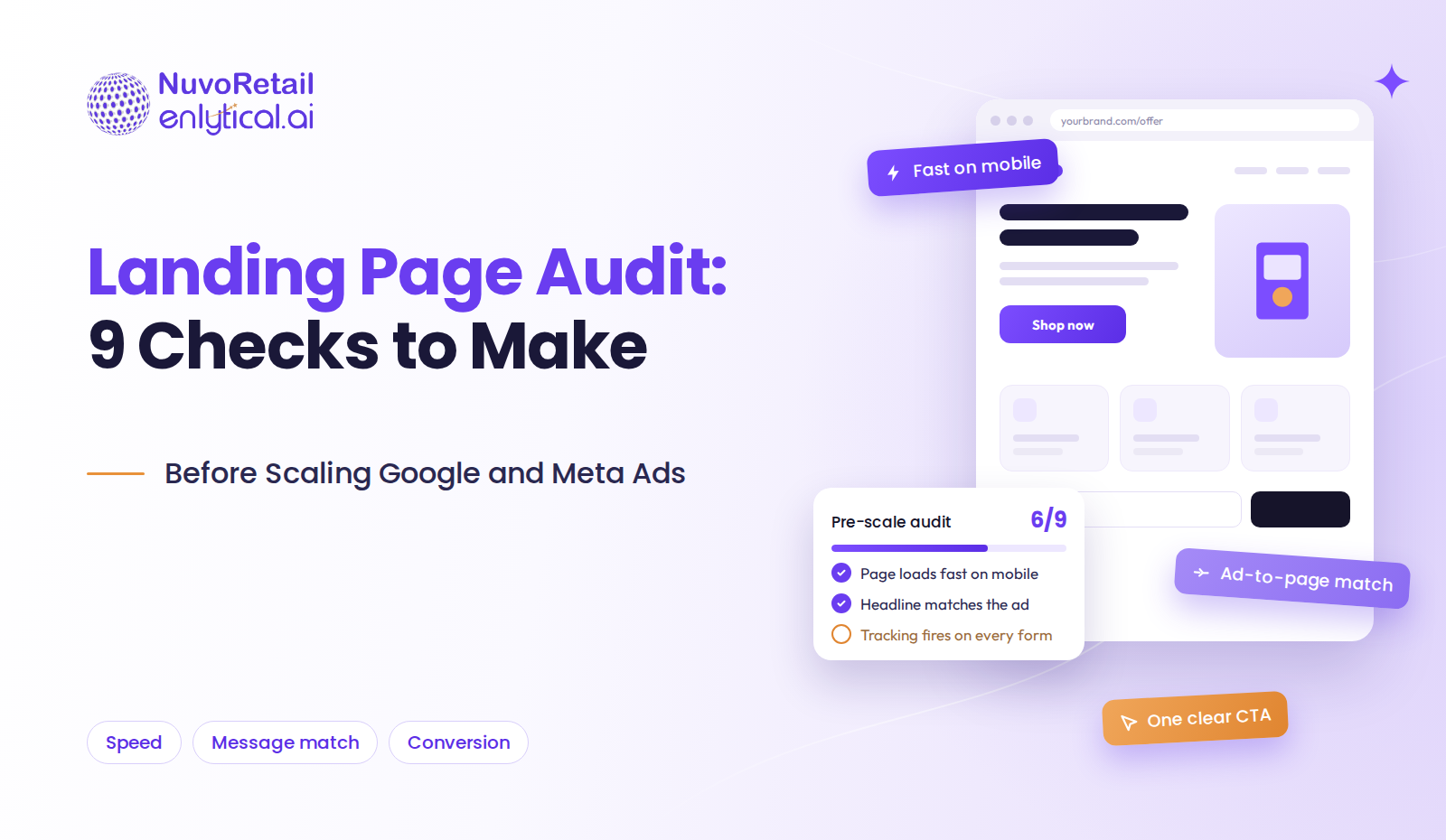
Here are the nine checks in our landing page audit, the ones we run before telling any brand to scale.
- Check 1: Message match
- Check 2: One page, one intent
- Check 3: Above-the-fold clarity
- Check 4: Mobile speed
- Check 5: CTA clarity
- Check 6: Form friction
- Check 7: Trust signals
- Check 8: Analytics events and conversion tracking
- Check 9: Lead handoff
- Your landing page audit scorecard
- Frequently asked questions
- Conclusion: Fix the page, then scale the spend
- Planning to scale your Google or Meta budget this quarter?
Check 1: Message match
The ad made a promise. Does the page keep it at first glance?
Message match is the first thing any landing page audit should look at. If someone clicks “Free skin consultation in 10 minutes” and lands on a generic brand homepage, they have to hunt for what they came for. Most won’t. Message match means the headline, offer and visuals on the page echo the ad that brought them there. It’s also the foundation of landing page optimization for Google Ads, because it feeds Google’s landing page experience signal, which affects your Quality Score and what you pay per click.
Quick test: Put each ad next to its landing page. Could a stranger tell they belong together in three seconds?
Check 2: One page, one intent
Search traffic and social traffic arrive in different moods. A Google searcher is already looking; a Meta scroller was interrupted. Sending both to the same page rarely works for either.
Map every campaign to a page built for its intent: high-intent search terms to a focused offer page, colder Meta audiences to a page that explains and builds interest first.
Quick test: List your top five campaigns by spend. If more than two point at the homepage, start your landing page audit here.
Check 3: Above-the-fold clarity
Before scrolling, on a phone, can a visitor answer three questions: what is this, who is it for, and what do I do next? If the hero section is a slogan and a stock photo, the answer is no.
Quick test: Show the top of the page to a colleague for five seconds, then ask them what’s being offered.
Check 4: Mobile speed
Most paid social traffic, and a large share of search traffic, is mobile. A slow page loses people before they see a single word. It’s also the easiest part of a landing page audit to measure.
Use Google’s Core Web Vitals as your benchmark: the main content should load within 2.5 seconds (LCP), taps should get a response within 200 milliseconds (INP), and the layout shouldn’t jump around while loading (CLS under 0.1). The heavy hero image, the chat widget and the third-party scripts are the usual suspects.
Quick test: Run your top landing pages through PageSpeed Insights and check the mobile field data, not just the lab score.
Check 5: CTA clarity
One page, one primary action. Competing buttons like “Book a demo,” “Download the brochure” and “Follow us” split attention and dilute conversions.
The CTA should say what happens next (“Get my free audit” beats “Submit”), appear above the fold, and repeat at natural decision points further down.
Quick test: Count the clickable actions on the page. Anything that doesn’t serve the main goal is a leak.
Check 6: Form friction
Every extra field is a reason to quit. Ask only for what you need to qualify and follow up, and nothing more.
Look for unnecessary fields, missing autofill, number keyboards that don’t appear for phone fields, unclear error messages and CAPTCHAs that block real users. For longer forms, a two-step layout (easy questions first) usually feels lighter.
Quick test: Fill in your own form on a phone, on mobile data, with one thumb. Time it.
Check 7: Trust signals
Paid visitors often don’t know you yet. Before they hand over a phone number, they want reassurance.
Place proof near the point of decision: reviews and ratings, client logos, certifications, real numbers, a visible privacy note beside the form, and clear contact details. Proof buried in the footer doesn’t count.
Quick test: Look at the form and the CTA. Is there a reason to trust you within one screen of each?
Check 8: Analytics events and conversion tracking
This is where a typical landing page audit stops too early. If conversions aren’t tracked correctly, Google and Meta’s bidding algorithms optimise towards the wrong signal, and scaling makes it worse.
Check that your key actions (form submits, calls, WhatsApp clicks) fire as GA4 key events and as conversions in Google Ads, with enhanced conversions where possible. On Meta, run the Pixel alongside the Conversions API and pass a matching event ID on both so Meta can deduplicate events instead of double-counting.
Quick test: Submit a test lead and confirm it shows up once in GA4, Google Ads and Meta Events Manager.
Check 9: Lead handoff
The conversion isn’t the finish line, and a thorough landing page audit doesn’t end at the form either. A lead that sits in an inbox for a day is a lead your competitor calls first.
Audit what happens after the submit: does the lead reach your CRM or sales team instantly, with campaign and keyword data attached? Is there an auto-reply or WhatsApp confirmation? And are qualified leads and sales sent back to Google and Meta as offline conversions, so the platforms learn to find more of your best customers, not just more form-fillers?
Quick test: Submit a lead at 9 pm on a Friday and see when, and how, someone responds.
Your landing page audit scorecard
Score each landing page on the nine checks before any budget increase:
| Score | What it means |
| 8–9 checks passed | Ready to scale. Increase budgets gradually and keep watching cost per qualified lead. |
| 5–7 checks passed | Fix first. Scaling now will raise costs faster than results. |
| 0–4 checks passed | Pause and rebuild the post-click experience before spending more. |
Frequently asked questions
Q. What is a landing page audit?
A landing page audit is a structured review of everything that happens after a visitor clicks an ad, from message match and page speed to forms, conversion tracking and lead follow-up, to find what’s stopping paid traffic from converting.
Q. How often should I run a landing page audit?
Before any major budget increase, when launching a new campaign or offer, and whenever conversion rate drops without an obvious change in the ads.
Q. Should Google and Meta Ads use the same landing page?
Usually not. Search visitors arrive with intent; social visitors often need more context first. Matching each page to its traffic source typically lifts conversion for both.
Conclusion: Fix the page, then scale the spend
The best ad in the world can’t rescue a page that loads slowly, asks for too much, or loses the lead after the click. Scaling should be the reward for a journey that already works, not a way to hope it will.
You don’t need a Google Ads strategist, a Meta conversion optimization expert and a conversion growth consultant all in the room to run a landing page audit. But you do need someone looking at the whole post-click experience, from the ad to the sales call, instead of just the campaign dashboard. That’s how we approach performance marketing at NuvoRetail: media, landing pages, tracking and lead handoff, optimised as one system.
Planning to scale your Google or Meta budget this quarter?
Request a paid-media and landing page audit with the NuvoRetail team. We’ll show you where your post-click journey is leaking, and what to fix before you spend another rupee