
Summarize this blog post with:




Do you think how does Quick Commerce Marketing effect your brand?
Well, it’s 8:47 on a Tuesday night in Gurugram. Priya realises she’s out of coriander, opens Blinkit, and has it at her door before the dal finishes simmering. Nine minutes. Magic.
That Sunday, the same Priya drives 20 minutes to a supermarket for her monthly stock-up: a 10-kg bag of atta, a 5-litre can of oil, detergent, rice. Quick commerce never even crossed her mind.
That gap between Tuesday night and Sunday morning is where India’s next $77 billion in quick commerce growth is hiding. According to the Google-Redseer report, the market is set to grow from about US$13 billion in FY2026 to as much as US$90 billion by FY2031 (YourStory). That’s nearly 7X in five years.
But here’s the twist: speed got quick commerce this far. It won’t get it the rest of the way. Winning the next phase takes a sharper quick commerce marketing playbook, one built around shopping missions, trust, assortment and data. At NuvoRetail, this is the shift we see every day across Blinkit, Swiggy Instamart and Zepto. Here are seven moves that brands should make now.
- 1. Why 10-Minute Delivery Is No Longer the Whole Story
- 2. Two Markets, Two Playbooks: Metros vs Non-Metros
- 3. Win the Monthly Basket, Not Just the Midnight Craving
- 4. Trust, Assortment and Price: The Three Deal-Breakers
- 5. Look Beyond Grocery
- 6. Turn Data Into Decisions
- 7. Build a Full-Funnel Quick Commerce Marketing Strategy
- Conclusion: The $90B Race Rewards the Smartest, Not the Fastest
- Is Your Brand Ready for the Next Phase of Quick Commerce Marketing?
1. Why 10-Minute Delivery Is No Longer the Whole Story
Quick commerce started as an emergency button. Today it’s a habit. Shoppers use it for replenishment, personal care and a growing list of non-grocery buys. In metros, its share of retail spending is projected to climb from around 6% to 20–23% by FY2031.
A bigger market doesn’t mean every brand grows with it, though. More brands chasing the same screen means costlier visibility and tougher categories. The real question isn’t “Should we be on quick commerce?” It’s “Are we built to win on it?” If you’re still weighing the channel, our breakdown of quick commerce vs e-commerce is a good starting point.
2. Two Markets, Two Playbooks: Metros vs Non-Metros
The growth will come from two very different places.
- Metros (~60% of incremental growth, US$40–50B): Users already know the apps. The job is to win a bigger share of their wallet, across more categories and larger, planned baskets.
- Non-metros (~40%, US$30–40B): Monthly transacting users are projected to jump from 12–16 million to 55–60 million. Awareness is high: over 95% of non-users in smaller towns already know what quick commerce is. Converting them is the hard part.
A premium Gurugram playbook won’t land in Indore or Coimbatore. Basket sizes, price sensitivity, trust cues and payment habits differ. Smart quick commerce brands budget, assort and advertise for each market separately.
3. Win the Monthly Basket, Not Just the Midnight Craving
Remember Priya’s Sunday supermarket run? The report puts numbers on it. Among occasional metro users, supermarkets take 27% of monthly grocery spend versus 25% for quick commerce, and monthly stock-ups make up about 42% of that spend.
Planned purchases play by different rules. Shoppers want bigger packs, wider choice, sharper prices and confidence in freshness. So, map your orders to shopping occasions:
- Urgent need: one product, right now
- Replenishment: the usual, on repeat
- Planned stock-up: the monthly basket
- Exploration: a first try in a new category
Each occasion calls for different pack sizes, pricing and quick commerce advertising.
4. Trust, Assortment and Price: The Three Deal-Breakers
Convenience gets the first order. These three decide whether the big basket ever moves.
Trust – Worries about stock freshness, storage and quality hold shoppers back. Clear product information, visible freshness cues and reliable fulfilment do more than any tagline. Strong listing content is where this starts, which is why our content development team treats every product page as a trust signal.
Assortment – A top-up needs a 500 g pack. A stock-up needs the 10 kg bag. The report flags bulk packs of staples like atta, rice and edible oil as a key gap. Listing your whole catalogue is not the same as listing the right one.
Price – The report’s August 2026 basket check tells the story:
| Basket | Quick commerce | Supermarket |
| 5-product top-up | ₹320–330 | ₹330–340 |
| 13-product monthly stock-up | ₹4,215 | ₹3,859 |
Quick commerce wins small baskets and loses big ones. Discounts can drive trial, but they can’t fix a weak value proposition for long. For tactics that work inside a single session, see our 5 proven quick commerce conversion secrets.
5. Look Beyond Grocery
Non-grocery categories such as beauty, personal care, home essentials and electronics are projected to grow from about US$3 billion to US$21–27 billion by FY2031.
But nobody buys a serum the way they buy milk. Search works when shoppers know what they want. Discovery needs richer content, clear differentiation, demos and creator-led stories. A separate Google–Deloitte report points the same way, forecasting that creators will become a trusted engine of commerce.
6. Turn Data Into Decisions
Sales, impressions and ROAS tell you what happened. Growth needs to know why. Low sales might mean weak demand, or a stock-out, poor search rank, an off price or ads hitting the wrong audience. Each needs a different fix.
| Question | What to check |
| Visibility | Do the right SKUs show for category searches? |
| Conversion | Are listings, price, ratings and availability closing the sale? |
| Assortment | Are high-demand SKUs or pack sizes missing? |
| Behaviour | Are buyers returning and growing their baskets? |
| Profitability | Is growth worth it after ad and promo spend? |
This is what NuvoRetail’s analytics platform, enlytical.ai, is built for: turning marketplace data into the next decision, not just the next report.
7. Build a Full-Funnel Quick Commerce Marketing Strategy
Studies now urge platforms to expand users, deepen wallet share and build trust. It also highlights Commerce Media Networks, which link retailer transaction signals with digital ad touchpoints. For brands, the lesson is simple: acquisition, engagement and retention can’t run in silos.
- Expand: reach new shoppers by market, category and occasion.
- Engage: grow repeat orders, cross-sells and planned replenishment.
- Elevate: build preference with clear content, demos and authentic stories.
- Optimise: connect ad spend, availability and conversion in one decision loop, backed by sharp performance marketing.
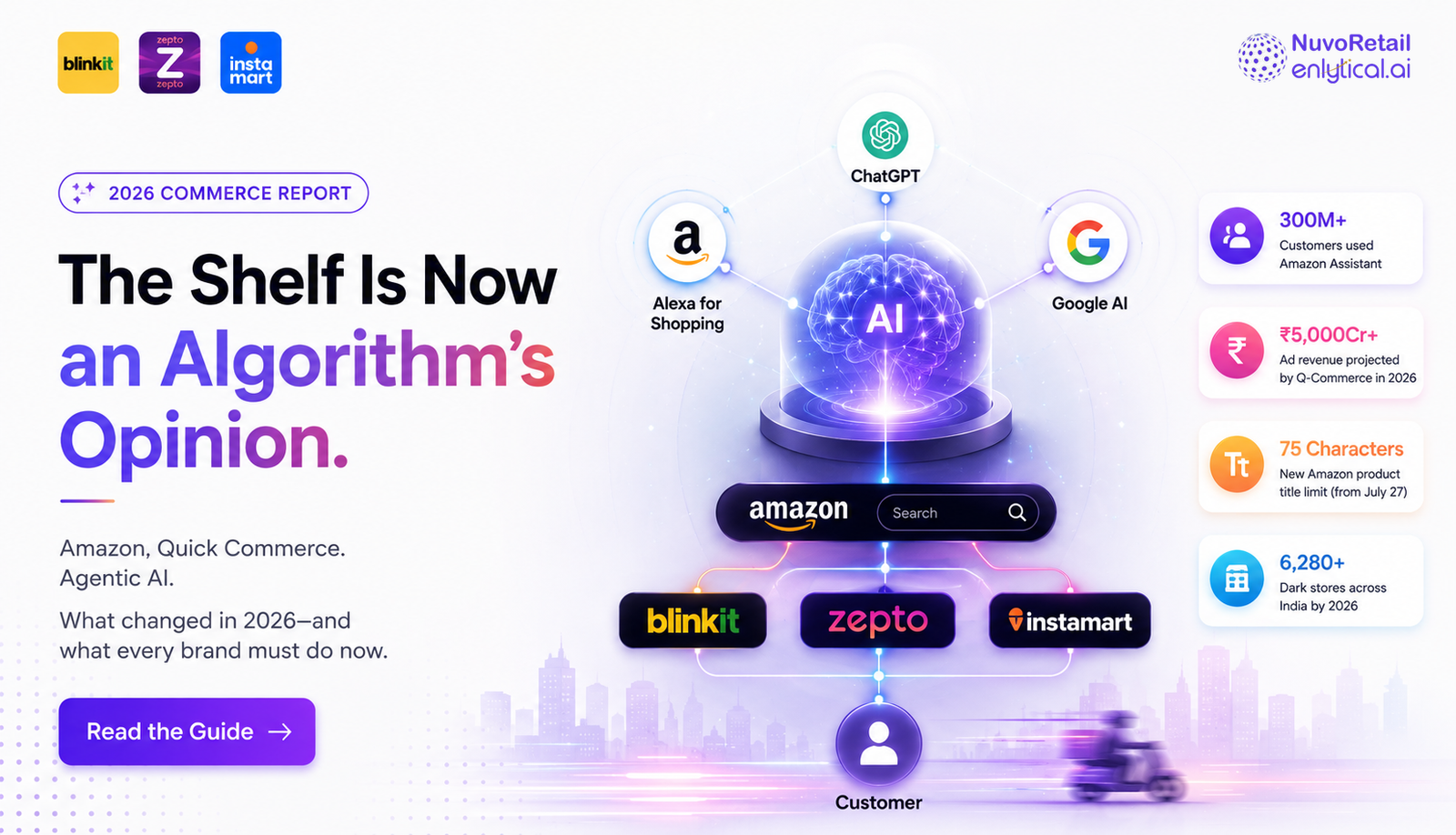
Heavy ad spend on a product that’s out of stock is money down the drain. A full-funnel quick commerce marketing strategy makes every rupee work together. For the bigger picture on how algorithms now shape the shelf, read Amazon, Quick Commerce Marketing & Agentic AI: What Changed in 2026.
Conclusion: The $90B Race Rewards the Smartest, Not the Fastest
Quick commerce marketing already changed how fast India shops. The next chapter is about how much India trusts it with the whole basket.
The brands that win won’t be the ones that spend the most or appear everywhere. They’ll be the ones that understand Priya’s Sunday, fix what stops her from switching, and execute on it week after week. That means the right packs, honest value, content that builds trust and data that drives decisions. New to the channel? Start with our quick commerce strategy for emerging brands, then see how Blinkit and Zepto actually work.
Is Your Brand Ready for the Next Phase of Quick Commerce Marketing?
Whether you’re launching on Blinkit, scaling on Swiggy Instamart or testing Zepto, NuvoRetail brings marketplace expertise, quick commerce advertising, content, analytics and automation under one roof.
Talk to our quick commerce marketing team and let’s turn your share of the $90B opportunity into real, profitable growth.
What’s stopping your shoppers from moving their monthly basket to quick commerce? Tell us in the comments below.