
Summarize this blog post with:




The Shelf Is Now an Algorithm’s Opinion
Something quietly historic happened this summer. For the first time, on the biggest shopping event of the year, a machine sat between the shopper and the product.
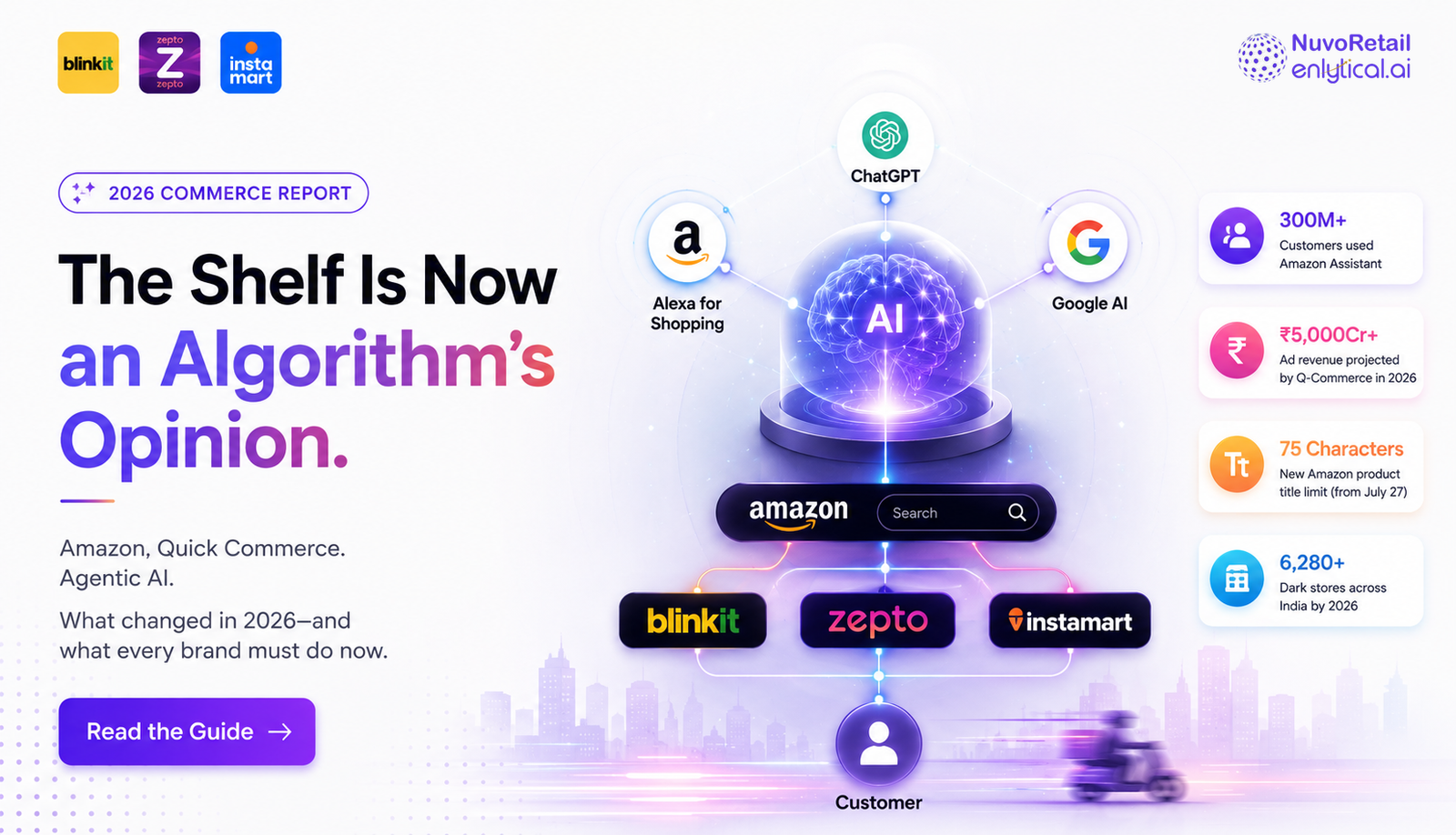
That single shift an AI reading, ranking, and sometimes buying your product before a human ever sees your listing is now playing out across every channel a brand sells on. On Amazon, it’s an assistant that summarises you before the shopper meets you. In agentic commerce, it’s an agent that transacts on the shopper’s behalf. On India’s quick commerce apps, it’s an algorithm that decides whether your product even appears on the screen.
At NuvoRetail, we help brands stay ahead of these shifts through data-driven quick commerce marketing services and Amazon marketing services. As consumer discovery becomes increasingly AI-led, success is no longer determined by visibility alone it’s driven by how effectively your products are understood, recommended, and prioritised by algorithms across every commerce platform.
This blog breaks down the four biggest changes shaping Amazon, quick commerce marketing, and Agentic AI in 2026. More importantly, it explains what each shift means for brands, advertisers, and marketplace teams and the practical actions you should take now to strengthen your quick commerce marketing strategy and stay competitive in the AI-first era.
- The Shelf Is Now an Algorithm’s Opinion
- Why Is 2026 a Turning Point for E-commerce Brands?
- 1. Rufus Is Gone – It Got Promoted to Alexa for Shopping
- 2. What Is Agentic Commerce, and How Does It Affect Brands?
- 3. How Big Is India’s Quick Commerce Marketing Market and Why Is It a Media Channel Now?
- 4. What Should Brands Actually Do About Their Quick Commerce Marketing Strategy?
- FAQ – Quick Commerce Marketing & Amazon SEO 2026
- Ready for AI-First Commerce?
Why Is 2026 a Turning Point for E-commerce Brands?
2026 is the year discovery got intermediated by AI on every surface at once. Shoppers increasingly start with an assistant, not a search bar; agents increasingly finish the purchase, not the shopper. That inverts the marketing funnel – awareness at the top no longer reliably pulls a buyer down, because a machine is making the shortlist first. The four shifts below are different expressions of that same structural change, and together they are why quick commerce marketing and Amazon SEO 2026 planning can no longer sit in separate spreadsheets.
1. Rufus Is Gone – It Got Promoted to Alexa for Shopping
On May 13, 2026, Amazon retired the Rufus brand and merged it with Alexa+ to create Alexa for Shopping – the same underlying shopping agent, but no longer a sidebar experiment. It now sits directly behind Amazon’s search bar, generating AI overviews above search results, building side-by-side product comparisons inside the results page, and curating personalised shortlists. For anyone running Amazon SEO 2026 campaigns, Alexa for Shopping is now the first “shopper” your listing has to convince.
Why the promotion? The economics. In its Q4 2025 results, Amazon disclosed the assistant had been used by more than 300 million customers and driven roughly $12 billion in incremental annualised sales. An assistant doing $12 billion doesn’t stay in a sidebar; it moves to where the shoppers actually are.
Prime Day 2026 (June 23-26 – the first June event since 2021) was the first major event with this AI layer in place. Adobe Analytics measured $26.4 billion in US online spend, up 9.3% year over year, with Amazon estimated to capture around 60.3% of US e-commerce during the window – its highest share since 2019. Shoppers could ask Alexa for Shopping to build a personalised deal guide, set price alerts, and even auto-buy.
One honest caveat: Amazon hasn’t released how much demand actually flowed through the assistant, so treat its role as Amazon-positioned rather than independently measured – the direction of travel still holds.
What Changed With Amazon’s Product Title Rules? (Amazon Product Title Optimization)
Announced via Seller Central on June 10 and effective July 27, 2026, product titles in every category except media must now be 75 characters or fewer, including spaces. Promotional language, repeated keywords, and decorative characters are banned. A new Item Highlights field gives you 125 additional searchable characters for the attributes that no longer fit – and those highlights appear in both search results and on the product detail page. This is the single biggest Amazon product title optimization change of 2026.
The enforcement is the real story. Amazon has tightened title guidance before – the January 2025 update capped titles at 200 characters – but never punished violations. This time, non-compliant titles get auto-rewritten by Amazon’s AI. Brand-registered owners get a 14-day window to review the AI-generated title and highlights; sellers who aren’t brand registered don’t get that courtesy.
Read the two moves together and the strategy is obvious: short, clean, human-readable titles for the mobile screen — and structured, searchable attributes for the AI reading everything else. This is Amazon SEO for 2026: optimising for machines first, humans second.
What Brands Must Do for Amazon SEO 2026
- Triage your catalogue by revenue, not by ASIN count. Rewrite your bestsellers’ titles by hand before July 27; let lower-value SKUs absorb the AI rewrite if you must – never your hero products.
- Keep your highest-value keywords in the 75 characters; move the rest into Item Highlights. The keywords don’t disappear, they relocate – and they stay searchable, which keeps your Amazon SEO 2026 rankings intact.
- If you’re brand registered, monitor the Review Listing Changes tool for the next month. A silently approved AI title on a hero ASIN can shift click-through and conversion overnight.
- Plan changes 6-8 weeks ahead. Amazon partners report the assistant needs that long to index listing updates. Last-minute optimisation before an event is now structurally too late.
- Write for questions, not queries. The assistant is optimised for a conversation with a shopper, not a keyword list. Keyword stuffing is now both a bad tactic and a policy violation.
2. What Is Agentic Commerce, and How Does It Affect Brands?
Agentic commerce is delegated shopping: a customer sets an intent and guardrails in plain language (“order trail-running shoes under ₹8,000 that arrive Friday”), and an AI agent handles discovery, comparison, and checkout on their behalf. Unlike a chatbot that answers one question, an agent pursues a goal across multiple steps – and transacts at the end. This is the frontier of agentic commerce marketing, and it runs on a different playbook than either traditional SEO or paid search.
The technology behind this shift is also transforming how businesses operate internally. Amazon has expanded its enterprise AI capabilities through Amazon Q, introducing AI agents that can automate workflows, retrieve business knowledge, and execute complex multi-step tasks. To learn more, explore Amazon Q’s AI agents and how Amazon Q is reshaping the way teams work with agentic AI.
July 2026 was the month agentic commerce marketing went from demo to live revenue:
- Salesforce made its Shopper, Buyer, and Merchant Agents generally available (July 6), with native ChatGPT integration live and Google Search/AI Mode and Gemini integrations rolling out.
- ChatGPT Shopping is now live for all US users, with Etsy and over a million Shopify merchants connected.
- Google’s AI Mode launched agentic checkout, with Wayfair, Chewy, and Etsy among the early movers.
- The Universal Commerce Protocol (UCP) is emerging as an open standard so agents can talk to commerce backends without bespoke integrations per merchant.
The forecasts aren’t small. eMarketer expects AI platforms to influence around $20.9 billion in retail spending in 2026 – nearly four times 2025. McKinsey estimates agentic commerce could redirect $3-5 trillion in global retail spend by 2030. And Adobe measured a 4,700% year-over-year jump in generative-AI traffic to US retail sites between mid-2024 and mid-2025.
What Agentic Commerce Marketing Means for Brands
- A new buyer has entered the market, and it doesn’t respond to emotion, urgency banners, or beautiful photography. Agents optimise for clarity, certainty, and ease of execution.
- “Agent legibility” is the new conversion rate. If your pricing, delivery windows, or returns terms are ambiguous or inconsistent, the agent skips your offer – and no human ever sees you lose the sale.
- There’s a real infrastructure gap: agent-driven demand shows meaningfully higher conversion potential, but most merchants convert agent traffic far worse than human traffic because their stack was built for browsers, not APIs. Closing that gap is the near-term opportunity for any agentic commerce marketing strategy.
- Persuasion still matters for humans. But being selectable by machines – clean catalogues, structured data, machine-readable policies – is now a parallel discipline you have to run alongside it.
3. How Big Is India’s Quick Commerce Marketing Market and Why Is It a Media Channel Now?
The race in quick commerce marketing has moved from speed to margin, and from margin to media. Eternal’s June-quarter shareholder letter (July 23) confirmed Blinkit widened its lead: 916.6 million orders in FY26 and revenue of ₹37,779 crore – nearly the combined scale of Zepto (₹22,624 cr) and Swiggy Instamart. Market-share estimates cluster around Blinkit ~46%, Instamart ~24%, Zepto ~22%.
The infrastructure numbers tell the real story. Per Redseer, India crossed ~6,280 operational dark stores by January 2026 – adding nearly 300 net new stores in a single month – with the network handling roughly 7.8 million orders a day. Another 2,000-2,500 stores are expected to open through 2026. Blinkit alone runs ~2,100+ and is targeting 3,000 by March 2027, while Amazon Now and Flipkart Minutes have each scaled past 500 dark stores – a fourth and fifth serious retail-media network entering the market.
And the money follows the attention. Datum Intelligence projects Blinkit, Zepto, and Instamart ad revenue will reach nearly ₹4,900 crore in calendar 2026, with total quick commerce marketing spend estimated at ₹5,000–6,000 crore annually. These are media businesses that happen to deliver groceries – which is exactly why quick commerce marketing now deserves its own line item in your media plan, not a leftover slice of your e-commerce budget, and why quick commerce marketing teams are being staffed and budgeted like a distinct retail-media discipline.
What It Means for Your Quick Commerce Marketing Strategy
- Your visibility is pincode-dependent. Every dark store serves only a 2-3 km radius. If you’re not stocked in a given store, you’re invisible to every shopper it serves – no matter how much you spend on quick commerce marketing. Distribution depth across the network is the ceiling on your ad ROI, not your budget.
- Intent is the advantage. Shoppers arrive with payment details saved and a basket open, and brands see 1.5-2x ROAS versus social platforms. But premium inventory (homepage takeovers, event bundles around the IPL or festival spikes) gets expensive fast – several lakh per week.
- Audit your ROAS math. Some platform dashboards calculate ROAS on MRP, not net selling price after discounts – which can inflate reported returns by 40%+. Always recalculate on net transaction value before scaling spend. It’s the single most common financial error brands make on these platforms.
- Tier 2/3 is the next frontier. Deloitte and Google project the category hitting $50 billion by 2030 (~10% of India’s e-retail). Early category ownership in new geographies is still cheap for quick commerce marketing teams. It won’t stay cheap.
4. What Should Brands Actually Do About Their Quick Commerce Marketing Strategy?
Zoom out and it’s one story told three ways: discovery is being intermediated by AI everywhere you sell. The funnel you learned is inverting – awareness campaigns can’t rescue a listing an AI won’t recommend.
The new quick commerce marketing and Amazon SEO stack has four layers, and they run in parallel with your existing marketing, not instead of it:
- Machine-readable truth – clean attributes, structured data, honest availability and delivery promises. This is what agents and assistants read first.
- Conversational content – listings, PDPs, and off-site content that answer real shopper questions, not just match keywords.
- Retail media as the floor, not the ceiling – paid visibility earns the impression; content and reviews earn the recommendation.
- Net-margin measurement – because dashboards flatter, and agents don’t.
The brands that win the next 18 months of quick commerce marketing won’t be the ones with the biggest budgets. They’ll be the ones whose products are legible – to shoppers, and to the machines shopping for them.
FAQ – Quick Commerce Marketing & Amazon SEO 2026
What is quick commerce marketing?
Quick commerce marketing is the discipline of winning visibility and sales on 10-minute delivery apps such as Blinkit, Zepto, and Swiggy Instamart – combining dark-store distribution, retail media (ads, homepage placements), and pincode-level availability, since a shopper can only buy what’s stocked and promoted in the specific dark store serving them.
When does Amazon’s 75-character title rule take effect?
July 27, 2026, in all categories except media. Non-compliant titles may be auto-rewritten by Amazon’s AI – making this a core part of Amazon SEO 2026 compliance.
What is Alexa for Shopping?
Amazon’s AI shopping assistant, formed by merging Rufus and Alexa+ in May 2026, now positioned behind Amazon’s search bar to generate overviews, comparisons, and personalised shortlists.
What is agentic commerce?
A model where an autonomous AI agent handles discovery, comparison, and checkout on a shopper’s behalf, working from a natural-language goal rather than a click – the basis of what marketers now call agentic commerce marketing.
How much do Blinkit, Zepto, and Instamart earn from ads?
Datum Intelligence projects Blinkit, Zepto, and Instamart ad revenue at nearly ₹4,900 crore in calendar 2026, within a total quick commerce advertising market of ₹5,000-6,000 crore a year.
How many dark stores are there in India?
Roughly 6,280 as of January 2026 (Redseer), with 2,000-2,500 more expected through the year.
| NOT SURE WHETHER AN AI WOULD RECOMMEND YOUR LISTINGS? We run an AI-readiness audit across Amazon and quick commerce – get in touch and let’s make sure your quick commerce marketing and Amazon SEO are built for the machines shopping for them. |
Ready for AI-First Commerce?
The way products are discovered is changing faster than most brands realise. Success is no longer determined by rankings alone it’s about ensuring your products are understood, recommended, and surfaced by Amazon’s AI, quick commerce algorithms, and the next generation of agentic shopping assistants.
At NuvoRetail, we help brands build future-ready strategies through Amazon Marketing Services, Quick Commerce Marketing, marketplace optimisation, retail media, and AI-driven commerce solutions. Whether you’re preparing for Amazon’s latest SEO updates or scaling across Blinkit, Zepto, and Swiggy Instamart, our team can help you stay ahead of the next shift.
Ready to future-proof your commerce strategy? Contact our experts for an AI-readiness audit and discover how to strengthen your Quick Commerce Marketing and Amazon SEO strategy for 2026 and beyond.